

$22 an hour comes to $45,760 a year working full-time — a solid number on its own, but the more interesting question at this wage is where it’s headed. Unlike lower hourly rates that often stay flat for years, $22/hour tends to sit at the start of a real career track with regular raises. So alongside the usual breakdown, this guide includes something most wage calculators skip: what this number could realistically grow into over the next several years.
$22 an Hour Right Now: The Full Breakdown
Standard formula: hourly rate × hours per week × weeks per year. Full-time (40 hours a week, 52 weeks, 2,080 hours):
$22 × 2,080 = $45,760 a year
| Time Period | Hours | Gross Pay |
|---|---|---|
| Hourly | 1 | $22.00 |
| Daily (8-hour shift) | 8 | $176.00 |
| Weekly | 40 | $880.00 |
| Biweekly | 80 | $1,760.00 |
| Semi-monthly | 86.67 | $1,906.67 |
| Monthly | 173.33 | $3,813.33 |
| Yearly (2,080 hrs, PTO included) | 2,080 | $45,760.00 |
| Yearly (2,000 hrs, 2 unpaid weeks off) | 2,000 | $44,000.00 |
What $22 an Hour Could Grow Into With Regular Raises
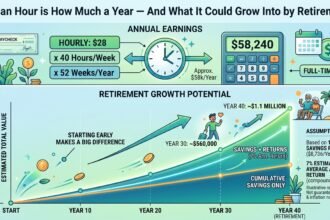
Here’s a projection worth running before you accept or negotiate a $22/hour offer. Using a 3% annual raise — a common, if not guaranteed, benchmark that roughly tracks average cost-of-living adjustments — here’s what the same job could look like several years out, assuming no promotions or role changes at all, just standard annual increases:
| Year | Hourly Rate | Annual Pay |
|---|---|---|
| Year 1 (starting rate) | $22.00 | $45,760 |
| Year 3 | ≈$23.34 | ≈$48,547 |
| Year 5 | ≈$24.76 | ≈$51,501 |
| Year 10 | ≈$28.70 | ≈$59,696 |
Two things worth taking from this: first, a flat annual raise alone gets you to roughly $60,000 a year by year 10 without a single promotion — useful context if a job offer only talks about the starting number. Second, this is exactly why a job with a documented, meaningful annual raise policy is worth more over time than a slightly higher starting wage with no such policy. Ask about raise history directly in an interview; it changes this table more than almost anything else.
$22 an Hour on a Part-Time Schedule
Here’s how the current yearly number scales at other common weekly hours:
Working past 40 hours a week regularly? The Fair Labor Standards Act (FLSA) requires 1.5× pay for non-exempt employees on those extra hours — overtime at $22/hour is legally $33/hour. Confirm your own numbers with the Overtime Calculator.
$22 an Hour After Taxes
Gross pay of $45,760 isn’t your real take-home. Here’s the estimate for a single filer with no dependents, using the 2026 IRS standard deduction:
| Item | Amount |
|---|---|
| Gross annual pay | $45,760.00 |
| Standard deduction (2026, single) | − $16,100.00 |
| Taxable income | $29,660.00 |
| Federal income tax (10%/12% brackets) | − $3,311.20 |
| FICA (Social Security + Medicare, 7.65%) | − $3,500.64 |
| Estimated annual take-home | ≈ $38,948.16 |
| Estimated monthly take-home | ≈ $3,245.68 |
That’s roughly $38,948 a year, or about $3,246 a month, federally. Texas and Florida charge no state income tax, so this estimate holds close there; elsewhere, state tax trims it further. Get a precise figure for your state with the After-Tax Salary Calculator.
Not tax advice. This is a general estimate for a single filer with the standard deduction and no other income. Your real take-home depends on your state, filing status, and benefits — check with a tax professional for specifics.
$22 an Hour Next to the Wages Around It
| Hourly Rate | Weekly | Monthly | Yearly |
|---|---|---|---|
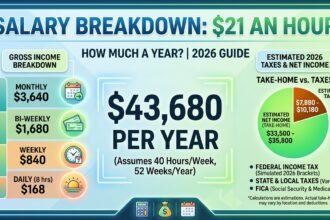
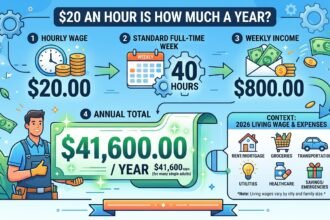
| $20.00 | $800 | $3,467 | $41,600 |
| $21.00 | $840 | $3,640 | $43,680 |
| $22.00 | $880 | $3,813 | $45,760 |
| $25.00 | $1,000 | $4,333 | $52,000 |
| $30.00 | $1,200 | $5,200 | $62,400 |
The gap from $22 to $25/hour is $6,240 a year. For the wage just below this one, see the $21 an hour breakdown.
Budgeting on $22 an Hour
With take-home pay around $3,246 a month, here’s a realistic single-person split:
At $22/hour, over $6,200 a year in savings is realistic without a strict budget — enough to fund a real emergency cushion and start meaningful retirement contributions in the same year. Build your own version with the Budget Calculator.
Making the Growth Curve Steeper Than 3%
The raise projection above assumes a passive 3% annual bump — here’s how to beat that curve rather than just ride it. Ask about the promotion path at hire, not after — roles with a documented ladder (associate → senior → lead) usually see faster growth than raise-only positions. Benchmark your pay against the market every year or two, not just at review time — a 3% internal raise on a below-market rate compounds slower than switching to a job already paying market rate.
Add a credential that unlocks a pay band jump, not just a small raise — certifications tied to formal pay scales tend to produce step increases rather than incremental ones. And track total compensation growth, not just the hourly rate — a strengthening retirement match or improving health plan can add real value even in years the base rate barely moves.
Straight Answers
At 40 hours a week for 52 weeks (2,080 hours), $22 an hour is $45,760 a year before taxes.
About $3,813 a month before taxes.
Roughly $38,948 a year, or about $3,246 a month, after federal tax alone.
With a steady 3% annual raise and no promotions, roughly $24.76/hour ($51,501/year) by year 5, and about $28.70/hour (≈$59,696/year) by year 10.
$660 a week, or about $34,320 a year.
$4,160 a year more, at the same 40-hour schedule.