

So someone just told you $14 an hour, and you’re doing that thing where you try to picture what it looks like as a “real” salary. Fair enough — let’s just get you the number. Working full-time, $14 an hour comes out to $29,120 a year before taxes. Now let’s actually unpack what that means for your paycheck, your taxes, and your month-to-month life, because the yearly figure alone doesn’t tell you much.
- Biweekly, Monthly, Whatever Your Paycheck Actually Looks Like
- What If You’re Not Working Full 40-Hour Weeks?
- Alright, But What Actually Hits Your Bank Account?
- Is $14 an Hour Actually Good, Though?
- $14 an Hour Next to $15 (and a Few Others)
- Making a Real Budget Work on $14 an Hour
- If You Want to Push Past $14/Hour
- Fast Answers
OK, So What Does $14 an Hour Actually Add Up To?
Here’s the formula, and it’s genuinely this simple: hourly rate × hours a week × weeks a year. Assume a normal full-time schedule — 40 hours a week, 52 weeks a year, which is 2,080 hours total — and:
$14 × 2,080 = $29,120 a year
That number assumes you get paid for every week, vacation included. If you don’t — say you get two weeks unpaid off — you’re really only being paid for 2,000 hours, which brings you to $28,000 a year instead. Small difference on paper, but worth knowing before you build a budget around the bigger number.
| Time Period | Hours | Gross Pay |
|---|---|---|
| Hourly | 1 | $14.00 |
| Daily (8-hour shift) | 8 | $112.00 |
| Weekly | 40 | $560.00 |
| Biweekly | 80 | $1,120.00 |
| Semi-monthly | 86.67 | $1,213.33 |
| Monthly | 173.33 | $2,426.67 |
| Yearly (2,080 hrs, PTO included) | 2,080 | $29,120.00 |
| Yearly (2,000 hrs, 2 unpaid weeks off) | 2,000 | $28,000.00 |
Biweekly, Monthly, Whatever Your Paycheck Actually Looks Like
Nobody budgets in “yearly” — you budget around whatever hits your account. So here’s the version that’s actually useful: paid every two weeks, $14 an hour is $1,120 biweekly. Paid twice a month instead (the 1st and 15th style), you’re looking at about $1,213 a check. If it’s a straight monthly figure you want, that’s roughly $2,427 before anything gets taken out. And per week, plain and simple, it’s $560.
What If You’re Not Working Full 40-Hour Weeks?
Totally normal — plenty of $14/hour jobs are part-time, or you’re juggling two of them. The math scales exactly how you’d expect:
Quick heads-up if you’re regularly pulling more than 40 hours a week: by law (the Fair Labor Standards Act), most hourly employees have to get paid 1.5× their normal rate for anything past 40 hours. So those overtime hours at a $14/hour job are really paying you $21/hour, not $14 — don’t undersell your own math. Want the exact breakdown? The Overtime Calculator does it for you.
Alright, But What Actually Hits Your Bank Account?
Here’s the part everyone actually cares about — not the $29,120 headline number, but what you keep after Uncle Sam takes his cut. Using 2026 federal numbers for a single filer taking the standard deduction:
| Item | Amount |
|---|---|
| Gross annual pay | $29,120.00 |
| Standard deduction (2026, single) | − $16,100.00 |
| Taxable income | $13,020.00 |
| Federal income tax (10%/12% brackets) | − $1,314.40 |
| FICA (Social Security + Medicare, 7.65%) | − $2,227.68 |
| Estimated annual take-home | ≈ $25,577.92 |
| Estimated monthly take-home | ≈ $2,131.49 |
So realistically, you’re looking at about $25,578 a year, or roughly $2,131 a month, after federal taxes — and that’s before any state tax gets involved. If you’re in Texas or Florida, good news: no state income tax, so this number holds up. Anywhere else, knock a bit more off depending on your state’s rate. Plug in your own state at the After-Tax Salary Calculator for the real answer.
Quick disclaimer: this is a ballpark estimate, not tax advice. It assumes a single filer with no dependents and the standard deduction — your actual number depends on your state, your filing status, and whatever benefits you’ve got. Talk to a tax pro if you want it exact.
Is $14 an Hour Actually Good, Though?
Honestly? It’s better than a lot of people are getting. The federal minimum wage has been frozen at $7.25/hour since 2009, so $14/hour is nearly double that. And it’s above the minimum wage in most states, though a handful of high cost-of-living states have already pushed their own minimums past $14 — meaning in places like parts of Washington, California, or the New York City area, $14/hour might actually be close to or below the local floor.
Everywhere else, it’s a genuinely solid entry-to-mid-level wage. Whether it “feels” good comes down almost entirely to your rent. In a lower cost-of-living town, $29,120 a year covers a modest but real life. In an expensive city, you’ll feel the squeeze no matter how you slice the budget.
$14 an Hour Next to $15 (and a Few Others)
$15/hour gets talked about so much it’s become a kind of unofficial benchmark, so here’s exactly where $14/hour sits relative to it:
| Hourly Rate | Weekly | Monthly | Yearly |
|---|---|---|---|
| $12.00 | $480 | $2,080 | $24,960 |
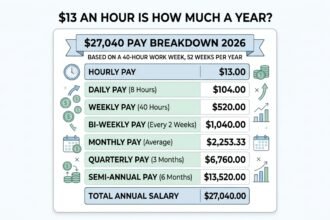
| $13.00 | $520 | $2,253 | $27,040 |
| $14.00 | $560 | $2,427 | $29,120 |
| $15.00 | $600 | $2,600 | $31,200 |
| $18.00 | $720 | $3,120 | $37,440 |
Notice how close $14 and $15 actually are — just $2,080 a year apart, or about $40 a week. If you’re negotiating a job offer, that’s a gap worth asking about directly; it’s smaller than most people assume. Curious how $14 stacks up a rung lower? Check the $13 an hour breakdown, or go straight to the $15 an hour guide if that’s the number you’re actually chasing.
Making a Real Budget Work on $14 an Hour
With take-home pay around $2,131 a month, here’s a realistic way to split it if you’re on your own:
The nice thing about $14/hour compared to lower wages is that savings line finally starts to look like something real — $220 a month isn’t life-changing, but it’s an emergency fund that actually builds. Want to plug in your own rent and bills instead of these estimates? The Budget Calculator will do the math for you.
If You Want to Push Past $14/Hour
A few honest, doable ways to move the needle: check whether you’re even eligible for overtime — a lot of people don’t realize they legally qualify for 1.5× pay and just never ask. Look sideways, not just up — switching companies for the same type of role often pays more than waiting for a raise at your current one.
Pick up a credential that actually moves the number — things like a forklift certification, a customer service or IT support certificate, or a CNA license tend to bump you several dollars an hour fairly quickly. And don’t ignore the whole package — a $14/hour job with real health insurance and paid time off can genuinely beat a $16/hour job with neither, once you do the math on what you’re actually keeping.
Fast Answers
At 40 hours a week for 52 weeks (2,080 hours), $14 an hour is $29,120 a year before taxes.
About $2,427 a month before taxes.
Roughly $25,578 a year, or about $2,131 a month, after federal tax alone.
It’s nearly double the federal minimum wage and above most state minimums, though a few high-cost states have pushed their own minimum close to or past it. Whether it feels “good” really comes down to your local rent.
About $2,080 a year more, at the same 40-hour schedule.
$420 a week, or about $21,840 a year.